The Scoreboard Is Not the Whole Measure of a Season
The scoreboard is not the whole measure of a season: track learning, contribution, and consistency with a simple record that makes personal progress clearer.
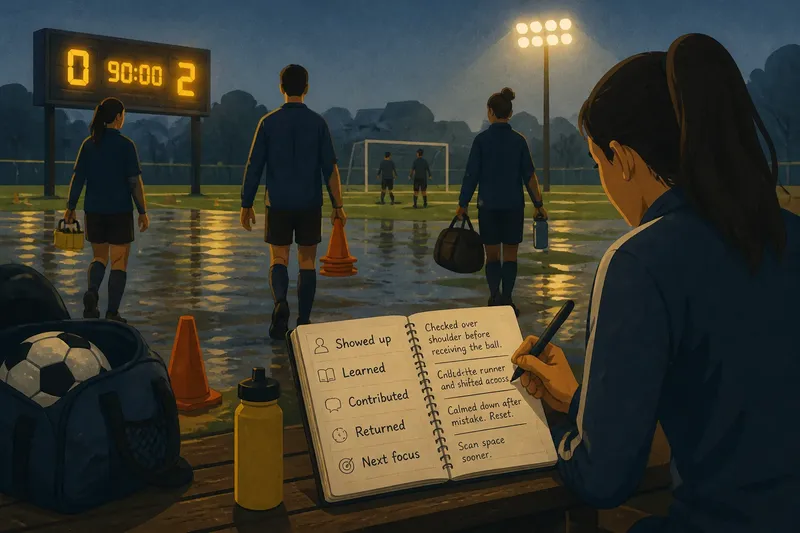
The scoreboard is still glowing as players stack cones and collect water bottles. Your team lost, but you kept your head after a mistake, made a useful pass under pressure, and turned up ready to play on a wet evening. Those details belong to the season, too. The scoreboard is not the whole measure of a season; it records an outcome, not the full story of a player’s effort or learning.
Read the result plainly
A score matters. It can tell you whether a team won, lost, or drew, and it may reflect how well players handled the contest that day. It cannot explain every contribution behind the result, and a single match can be shaped by conditions, opponents, availability, or a bounce that went the wrong way.
Try separating the result from your judgment of yourself. “We lost” is a fact. “I made no progress” is an interpretation, and the first does not prove the second. Likewise, a win can feel satisfying without meaning that every part of your game is improving.
Keep the score in your season notes if you care about it. Just leave room beside it for a detail the scoreboard cannot show.
Notice the learning
Learning is often smaller than a dramatic breakthrough. It may be noticing space sooner, recovering your position after a run, choosing a safer pass, or asking a teammate what they saw. These moments are easy to miss if reflection begins and ends with the final score.
After a game, write down one thing you understand better than you did before. Make it observable: “I checked over my shoulder before receiving the ball” says more than “I played smarter.” If you are still learning the sport, note a rule, movement, or piece of game language that now makes more sense.
Say you play community basketball and keep losing possession when a defender closes in. After a game, you note that you often receive the ball with your back to open space. At your next session, you try turning your body before the pass arrives. The useful sign to watch for is whether you can see a teammate or a clear route sooner—not whether the next match ends in a win.
Count quiet contributions
Some valuable work rarely appears in a box score. A defender may communicate early, cover a teammate who has moved forward, or help the group reset after a scramble. In a doubles match, a player may keep encouraging a partner and make the next point easier to approach after an error.
When you reflect, name the action and its purpose. “I called the runner and shifted across” is concrete; “I was a good teammate” is broader and harder to assess. This is not an invitation to award yourself a private trophy for every small task. It is a way to notice what you contribute, including the work that helps someone else do theirs.
Choose one contribution to carry into your next game. A clear call, a quick recovery, or a calm response after a mistake can give your attention somewhere useful to land.
Track consistency gently
Consistency is not a spotless attendance record or a promise to perform the same way every time. It is a pattern of returning to the parts of sport you can influence: preparing, participating, listening, and trying again after an awkward session. People miss games for ordinary reasons, and their circumstances can change across a season.
Use a small record rather than a ranking. A notebook, calendar, or note on your phone can hold a few words after each game:
- Showed up: Note whether you played, supported, or had to sit out.
- Learned: Name one choice, skill, or rule that became clearer.
- Contributed: Record one action that helped the team or a partner.
- Returned: Note how you responded to a difficult moment or mistake.
- Next focus: Choose one manageable detail to notice next time.
Keep the entries brief. A sentence is enough; the point is to make a season visible without turning it into an audit. If you miss a week, resume when you can rather than filling the gap with invented judgments about what it means.
Use the record fairly
At the end of a stretch of games, read your notes for recurring themes. Perhaps you communicate more readily, recover your focus faster, or have become more comfortable asking for feedback. A pattern can be meaningful even if it does not show up in the results.
Be specific about what your notes can and cannot tell you. They are personal observations, not a formal assessment of ability. If you want technical feedback, ask a coach or experienced teammate to watch for one defined aspect of play. You might ask, “Am I getting into position early enough to offer a passing option?” That is easier to discuss than “Am I improving?”
Keep comparisons close to your own experience. Another player’s role, playing time, or starting point may differ from yours, and comparing totals can flatten those differences into a ranking. Your notes are most useful when they help you decide what to notice or practice next.
Questions about progress?
What if I played badly despite the win?
Enjoy the win, then identify one part of your play that felt uncertain or rushed. A positive team result and a useful personal reflection can sit side by side.
What if I played well in a loss?
Name the actions that felt composed or effective, and note what you want to carry forward. The loss remains real, but it does not erase those details.
How often should I reflect on a season?
A short note after a game or practice is enough if it suits you; some players prefer a quiet review every few weeks. Choose a rhythm you can keep without making reflection feel like another obligation.
Should I share my notes with my coach?
Share a specific question or observation if you want feedback, and keep private details to yourself. A coach can respond more usefully to a clear moment in play than to a broad verdict about your potential.
Keep the season human
Sport includes results, but a season also consists of decisions, relationships, useful repetitions, and the willingness to return after a frustrating day. A personal record can make those parts easier to remember without pretending every game was a triumph.
When you review your season, let the scoreboard answer the question it can answer: what happened in the match? Then use your notes to ask what you learned, how you contributed, and what you want to carry into the next game. That broader view can help you leave the field with a clear intention for what to notice or try next, whatever the result.